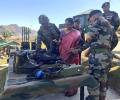
'We must look at the entire question of military preparedness anew, taking into account the new realities,' says Vice Admiral Premvir Das (retd).

This is the first time an Indian shipyard has been commissioned to design and build a warship to specifications formulated by a buyer country. This marks an important first landmark in the Bharatiya Janata Party-led government's drive to increase defence exports.

There's still little indication of forward movement in Indo-US defence relations.

'The previous (Congress) government at least did not veto provisions of the cattle laws.' 'The BJP is actively weakening the provisions.' 'The BJP government tried to export goats from Nagpur for slaughter to the Middle East.' 'The whole country was aghast and offended. We are a country of Ahimsa.' 'The BJP has incentivised the butcher industry so meat export has gone up, live animal export has gone up, leather export is on the rise, smuggling has gone up.'
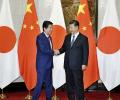
'Both Japan and China face a common challenge: How to deal with Trump.' 'The trade war with the US seems to have facilitated/hastened Abe's China visit, the first by a Japanese prime minister since 2011,' points out Dr Rajaram Panda.

His view will be shaped by his perception of US world interests and India's economic performance relative to China.

Meet Cassie de Pecol, a 27-year-old traveller from Connecticut, United States, who visited 196 countries in 18-and-a-half months, making her the fastest person to visit every country in the world.

The PM's vision of a lean, agile, mobile and technology driven force requires more than 1.7 percent of GDP that it now gets.

In a few years from now, India will be looking at an entirely different type of military adversary across the borders, in our waters, in the air, in space and in our communication networks, says Nitin Pai.

China's South China Sea build-up and 'territorial sea' construct potentially affects 55 percent of Indian trade passing through the region. Hence, coordinating with the US and Japan could provide dividends to India in the longer run,' says Srikanth Kondapalli.

The spectacular Milky Way over the picturesque Bavarian mountain, Herzogstand, the remarkable Horsehead Nebula and the Flame Nebula, a vast cloud of gas and dust where new stars are being born; the Royal Observatory's Insight Investment Astronomy Photographer of the Year 2019 has once more received thousands of outstanding images. The competition, which is run by the Royal Observatory Greenwich, sponsored by Insight Investment and in association with BBC Sky at Night Magazine, is now in its eleventh year and has broken the record number of entries once more, receiving over 4,600 entries from enthusiastic amateurs and professional photographers, taken from 90 countries across the globe. The winners will be announced on September 12, and an exhibition of the winning images from the past years of the contest will be on show at the National Maritime Museum in Greenwich from September 13.
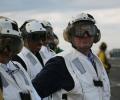
'The days are gone when we only deal with India as the other side of the Pakistan coin or Pakistan as the other side of the India coin.'

PM Modi seems to be gradually ending India's strategic ambiguity

You must visit these wonderful places across the globe to experience their rich and vibrant culture.

Outlining seven principles of engagement for closer cooperation between India and China, Prime Minister Manmohan Singh on Thursday said the two countries should show sensitivity to each other's interests and sovereignty and move quickly to resolve the boundary issue.

Praising the US for turning barriers into bridges of partnership, he said that America had stood with India when the support was needed the most, like when terrorists attacked Mumbai in November 2008 and in other economic endeavours as well

To make it possible to attract the best of our young people to join the armed forces, all university courses anywhere in India should include compulsory National Service for a total period of six months, says T Thomas

'Difficult issues should not be brushed under the carpet, but should be raised upfront, particularly by India. While engagement and dialogue are always welcome and desirable, there should be some tangible results. Mere signing of agreements, MoUs, joint declarations are not enough.'

Here's the full text of Prime Minister Narendra Modi's address to the United States Congress.

Fifty per cent of bank restructured assets were in infrastructure, steel, power and telecom sectors.

'Over the last two decades, the India-French relationship has grown steadily, no major political difference having darkened the sky between Paris and Delhi,' says Claude Arpi.
.jpg)
Modi government must push reforms at a fast pace to restore growth.
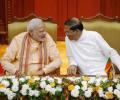
'What we have heard from the Sri Lankans is their desire to have a foreign policy that allows Sri Lanka to best advance its own interests rather than a foreign policy that relied solely on one relationship.' 'We think this is an attitude that makes a lot of sense. India and Sri Lanka have many areas of shared interests, and it's certainly welcomed by us to see that deepening of those ties.'

Prime Minister Narendra Modi delivered an impassioned speech to the United States Congress.

The IPCC has blamed man-made emissions for warming of the globe and long term climate change. Limiting climate change, therefore, will require substantial and sustained reduction of greenhouse gas emissions. This is the message to politicians and policy makers of the world, says Dinesh C Sharma

Text of PM Narendra Modi's press statement after delegation level talks with US President Obama at the Hyderabad House in Delhi.
'Modi and Abe are working seriously for India-Japan bonhomie to grow stronger.' 'It is a win-win situation for both countries and the future look promising,' says Rajaram Panda, the Indian Council for Cultural Relations India Chair Visiting Professor at Reitaku University, Japan.


In bilateral interfaces relations with China have also to be given due weight, opines Premvir Das

Excerpts from Prime Minister Narendra Modi's speech at the Combined Commanders Conference on board the INS Vikramaditya at sea, off the coast of Kochi.

The new equation between 'Namo' and 'Barack' may well 'convert a good start into lasting progress.'

Stating that India is new bright spot of hope and opportunity for the world, the prime minister said India among other things is igniting the engines of its manufacturing sector and making its farms more productive and more resilient.

'Chinese leaders rarely receive their foreign guests in cities other than Beijing. Such respect for India!' 'Does it mean that Modi could replicate "the warmth and unconventional way" by sending Indian troops into Tibet, as Xi did in Chumur (Ladakh) when he arrived in India? Of course, Indians are far too polite to do so,' says Claude Arpi.

'This has been an ongoing process,' says Ambassador B S Prakash, India's former consul general in San Francisco, 'but I believe a Modi visit to the West Coast can be a force-multiplier.'

The failure to restructure our armed forces in line with contemporary needs 14 years after the Kargil war will impose strategic costs beyond just delays and scandals, says Nitin Pai

One thing Beijing must understand is that India is not obsessed with being a threat to China but only wants a rightful place for itself in the world, says Sanjeev Nayyar.

In the years to come, India's space assets will play a much bigger role if and when hostilities break out on our borders, says Pallava Bagla.

'If the dimensions of the strategic partnership worked out by India and the US seem like a grand alliance targeted at you-know-who, China had better realise that it has fathered it,' says B S Raghavan, a long time observer of China.

'We have a common way of looking at the world, a common way of thinking, and a common set of values that predispose us to be partners. And our interests overlap greatly,' Dr Ashton B Carter, America's next defence secretary, told Aziz Haniffa/Rediff.com in an exclusive interview.

In spite of irritants and hiccups in the relationship, a few deliverables are expected of the prime minister's visit to China, says Rup Narayan Das.
